

A Special Weave for the RHS Chelsea Flower Show
In celebration of our third return to the RHS Chelsea Flower Show, we’ve woven a special run of kitchen cloths – fittingly named the ‘Chelsea Tea Towel’.
Each tea towel is woven on our restored Lancashire looms, which date back to the late 1800s. The unique feature of these antique looms is their shuttle, the bobbin inside which lies the yarn-wound pirn, and which carries the weft (left to right) threads across the warp. The special characteristic of shuttle loom weaving is its ability to produce a true selvedge, a self-bound edge that requires no extra hemming. We’ve left the true selvedge exposed on the short ends of our Chelsea Tea Towel, as a hallmark of traditional craftsmanship.


Fitting to the floral theme of the show, each tea towel features a delicate floral design, brought to life on our looms using an antique handweaving pattern. This pattern is drawn from a historic book of weaving, reimagined into colourful expression on our looms. A design that comfortably finds its place in our range – merging traditional weaving techniques with contemporary designs and palettes.

Traditional Weaving – The Back Story of our Lancashire Looms
At the Mungo Mill in Plettenberg Bay, you’ll find a cross-section of weaving machinery and technology that spans from pre-industrial to present-day. Included in our collection, are two original Lancashire looms, carefully restored by our Master Weaver, Stuart Holding.
Stu, who grew up in High Bentham, completed his apprenticeship in the Yorkshire silk mills in the 1960s – an experience that cultivated a lifelong passion for cloth-making. A few decades later, he was gifted two antique Lancashire looms, on which he began weaving runs of tea towels from his studio in Plettenberg Bay.
With the launch of our UK/EU store, and our showcase at the RHS Chelsea Flower Show, Stu’s journey comes full circle. What began in the mills of Yorkshire several decades ago, and took shape in South Africa, has now returned to the UK… Quality, natural fibre woven textiles – in your area (or at your door).

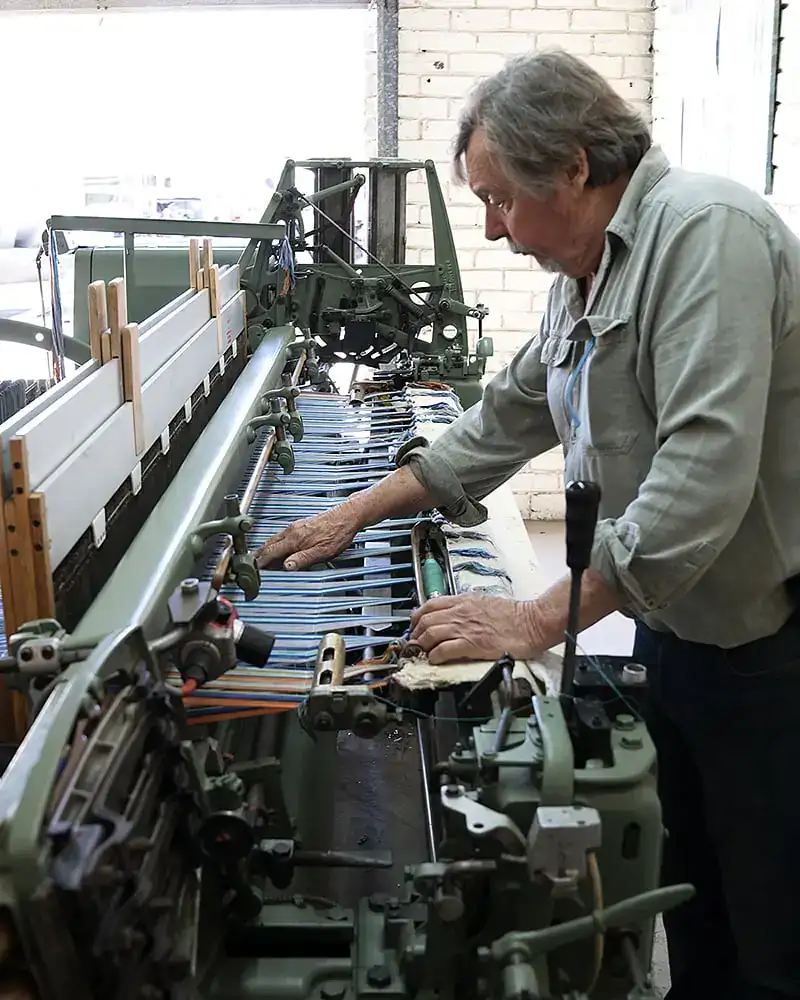
From Yorkshire to South Africa – Stu Holding’s Journey
At 16, I started my apprenticeship at the Wenning Silk Mills, spending five years “going through the mill” as the saying goes. It was there I developed a deep respect for the craft of weaving. To this day, the transformation of yarn into fabric amazes me. Standing in the Mungo Mill today, watching the first few metres of cloth come off the loom, still blows my hair back.
In 1998, I was gifted two Lancashire looms dating back to the 1880s. These were the very looms I had trained on during my apprenticeship. I refurbished them and started weaving small runs of cloth in a studio at the back of Old Nick Village. I kept the doors open, allowing visitors to watch the weaving process. This connection between the maker, the product, and the process became fundamental to Mungo’s philosophy.
As we expanded, we built the Mungo Mill in 2017, a double-volume building next to our original retail store. Today, the mill houses close to 100 employees and about 20 looms. Visitors can witness over 150 years of weaving technology, from warp-weighted weaving devices to antique Lancashire looms, and even the latest state-of-the-art Dornier machines, which were custom-built for us in Lindau, Germany.
– from the blog, From Yorkshire to South Africa | Q&A with Mungo Founder, Stuart Holding


